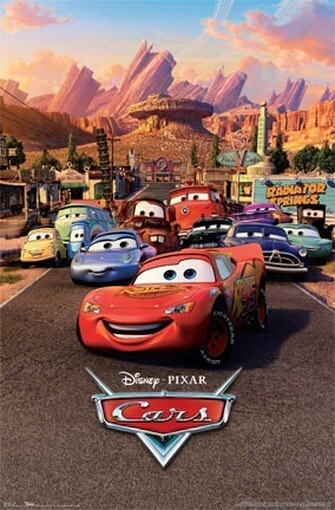
Cars (2006) · John Lasseter
The Rio Bravo of animation
Always has it left me baffled how a good number of people will dismiss Cars as B-tier in Pixar’s canon or as an outlier to the S-tier works they put out in the 2000s when long I have held the belief that it holds a rightful and deserving place as being apart of that pantheon. Maybe it is just the bias’s of nostalgia kicking in for me because of all of Pixar’s films this is the one I am the most nostalgic for (especially so because of the merchandising I used to collect heavy as a kid) but as the older I’ve gotten, I’ve come to love Cars and its aesthetic more and more because of its small-town 1950s-early-60s diner-culture aesthetic, made even more resonant when you have Paul Newman (who to me has always been an embodiment of this specific aesthetic) in it.
This is Pixar at their most American, and honestly, if one were to dismiss the fact that the characters you see on screen are literal sentient cars, you’d realize how all these characters feel the most modern and grounded in our reality than any other characters in Pixar’s films. Everything about Cars feels so natural, and I think that very much has to do with the fact that it’s so relaxed and comfortable in taking its sweet time. You don’t really get a lot of animated films that you could describe as being a “hangout movie”, and Cars is exactly that. The Rio Bravo of animation where much of your time you are spending with these characters doing their own thing, almost like a series of vignettes - tractor-tipping, cruising through the nature of Route 66, entering and absorbing all the different shops in Radiator Springs.
Each of the cars of the town have so much layers to their one-of-a-kind personalities, and the heart of this depth is tenderly realized in what is the most interesting and poignant contribution to the film’s ideas, and that’s in the flashback scene where we learn how Radiator Springs slowly became a ghost-town. For some, it raises a very sentimental and close-to-home rendering of the feelings of having to watch a community you loved and saw grow and flourish in its heyday, only to see one-by-one the people and the stores that brought the town life begin to leave. Pixar has such a moving way of taking concepts commercially-viable for children but in the process adding so much adult-depth and meaning to their writing that any grown-up watching can find something in the work to bring a piece of themselves to. As someone who always has longed to live in a time I never lived, that particular scene hits home for me because what it represents is the fading away of a piece of history that was, to some, their entire world that brought such simplicity and joy to their lives, much like the town of Anarene, Texas in Peter Bogdanovich’s The Last Picture Show, a film which I kept thinking of greatly during my rewatch today of Cars. It’s one of the most interesting real-life topics of interest that Pixar could have possibly added to any of their films, and they executed it to perfection here.
I love Cars, I never stopped loving Cars, and I wish it had more of an S-tier reputation because I believe it is as heartfelt as all the other Pixar movies to deserve it.
Reviewed on Letterboxd on 16 February 2025