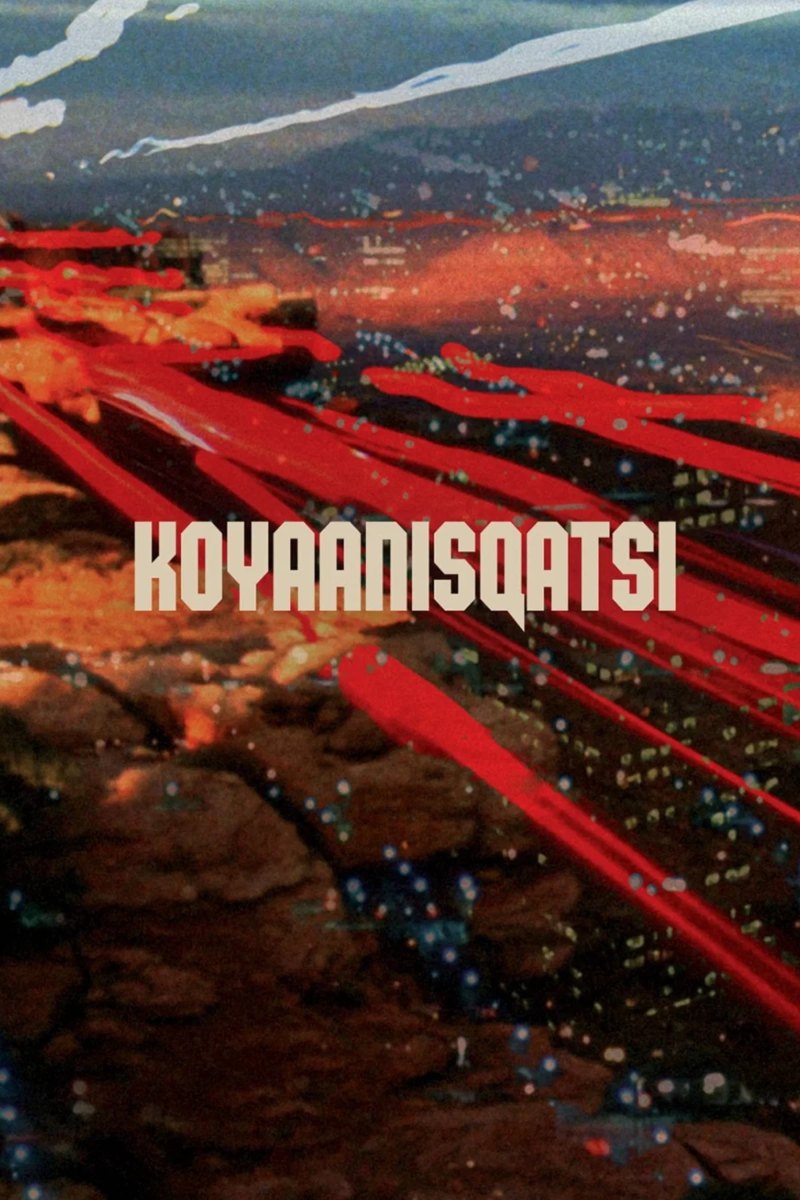
Koyaanisqatsi (1982) · Godfrey Reggio
A state of life that calls for another way of living
“ko.yaa.nis.qatsi (from the Hopi language), n.
- crazy life. 2. life in turmoil. 3. Life out of balance. 4. life disintegrating. 5. a state of life that calls for another way of living.”
I was prepared to dismiss Koyaanisqatsi off during the first half an hour as a film featuring pretty shots and nothing more. When it’s ideas finally clicked for me, I was unable to escape from its arresting visual grip until the very end.
It’s beyond impressive how Koyaanisqatsi, in its 86 minute runtime, is able to open your mind to an ocean’s worth of thought. There’s a montage three-quarters in of a birds eye view of city night life juxtaposed with the close-up of circuitry from a computer motherboard. They both look EERILY similair. Of all the shots that establishes the essence of what Koyaanisqatsi is trying to depict, to me, this was the one that unnerved me the most.
Society, nature and existence is one giant machine that cannot function without progress and movement. Once that movement stops, everything collapses. I’ve never seen anything like Koyaanisqatsi before in how it criticizes nearly every so-called “achievement” of what we human beings have created and how we have ordered it without even a word said. No political positions taken and no “ism’s” to replace the old and fix what supposedly doesn’t work. Nearly every aspect of modern society here is depicted as a mistake. A very pessimistic, apocalyptic conviction to hold, but one that I believe in the last few years holds up more than ever, especially as we enter a future where our lifelong role and contribution to it is uncertain.
Last year, I was reading the book The Magic Mountain by Thomas Mann, and there was one paragraph that I just had to highlight at the time because of the tragic irony I found in it when you read it with today’s world in mind:
“Technical progress, he said, gradually subjugated nature, by developing roads and telegraphs, minimizing climatic differences; and by the means of communication which it created proved itself the most reliable agent in the task of drawing together the peoples of the earth, of making them acquainted with each other, of building bridges to compromise, of destroying prejudice; of, finally, bringing about the universal brotherhood of man. Humanity had sprung from the depths of fear, darkness and hatred: but it was emerging, it was moving onward and upward, toward a goal of fellow-feeling and enlightenment, of goodness and joyousness; and upon this path, he said, the industrial arts were the vehicle conducive to the greatest progress.”
The book released in 1924 and takes place in the years just before world war one. In an era where instantaneous communication with the world was nearing its cusp, its harrowing to read this passage now, in the year 2026, and see that society coming together to create something bigger has fundamentally left humanity more divided, broken and unhappy than it’s ever been, who are forever trapped in a superficial ants nest that feeds off of their energy and their suffering in order to run.
The first shot of Koyaanisqatsi is of ancient cave paintings. One of the last shots is of a rocket trying to take off that explodes mid-flight. Humanity’s earliest achievement juxtaposed with humanity’s final quest on Earth - to reach for the stars. A nihilistic note to end the film on, one that suggests that nature and existence will outlive civilization, for as Marvin Gaye put it bluntly in “Save the Children” from the What’s Going album, “who really cares to save a world that is destined to die?” No one, because everyone is preoccupied with their own problems.
Life unquestioned is life lived in a religious state - Godfrey Reggio
Reviewed on Letterboxd on 20 June 2026