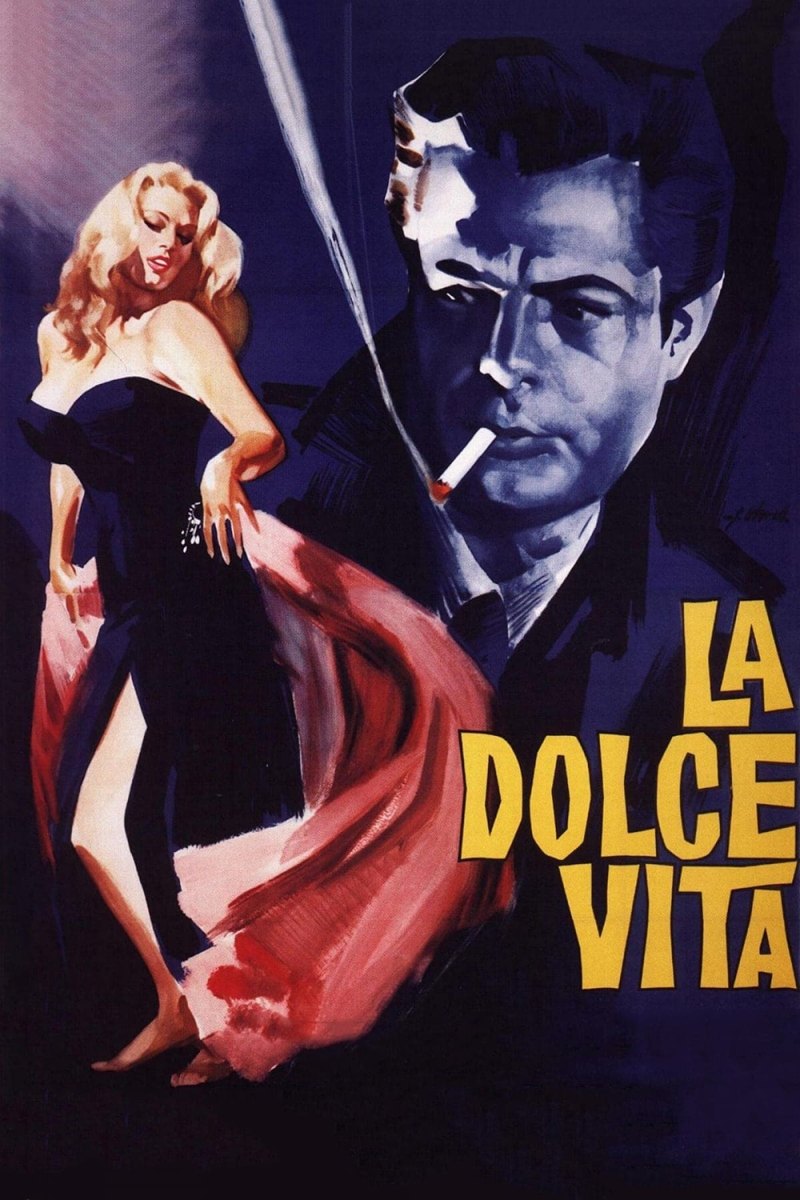
La Dolce Vita (1960) · Federico Fellini
Lost souls in an ever-changing Rome
“Even the most miserable life is better than a sheltered existence in an organized society where everything is calculated and perfected.” - Steiner
Lost souls in an ever-changing Rome. Perhaps all that glitters isn’t gold, despite the fact we were promised a three-hour film of what is supposed to be “The Sweet Life”.
Even in a city larger than life as Rome, love, happiness and la dolce vita cannot be found, even in those (like Marcello’s friend Steiner) who seem to have it all. Success, fame, wealth, a loving wife and two children, the very goals that every man wishes to cross off their list during their time on Earth. Even when obtained, it can still leave a void in one’s life, either there’s something missing or nothing more to gain.
Marcello is not the only one completely lost in his endless drifting and search for purpose. From the men and women of Rome’s café society and the many parties and soirees, everybody is dejected. Even behind all the laughs, the sex, the cigarettes and the fame lies a mask, hiding faces swelled up in tears.
“By 1965 there’ll be total depravity. How squalid everything will be.”
Like Antonioni’s L’Avventura released in the same year, La Dolce Vita acts as a cautionary tale of the things to come, not just in it’s depiction of a society slowly drifting in to directionless territories, but also of the degradation of a nation, it’s culture, ideals and history.
In the film’s first scene, a helicopter carrying a statue of Jesus Christ flies over the city of Rome, followed seconds later by Marcello and the rest of the men in the copter teasing and lusting over a group of women sunbathing on a roof. The Italy of old, the Italy of divine worship, is now making way for a new Italy, an Italy where religion and worship are no longer potential places of solitude and comfort for the lost.
By the end of the 1960s, with the advent of the psychedelic era and the sexual revolution, the prophecies that this film tried to warn the world about had come true by 1965. Antonioni’s Blow-Up is really just filling in the gaps and showing the prescient reality of what La Dolce Vita had envisioned. But at the same time, the film also tries to suggest, with the use of Marcello’s father, that this aimless pondering isn’t anything new and it’s always been like this. Despite the fact that Marcello’s father was never really present during his upbringing, they have a good bond with one another, which may be attributed to the fact that Marcello grew in to the man his father was during his youth. An unfaithful womanizer and a man longing to be out on the town rather than the confines and comfort of his own home, an environment not suited for his type, which is why Steiner, who deep down harbors these sentiments, reaches his breaking point and commits the horrible atrocity towards the film’s conclusion.
Something that a lot of Italian filmmakers at the time had predicted on screen is the death of the art of architecture, substituted for buildings of a more modernist, westernized and minimalistic look. Compare the beautiful architecture and landmarks of Rome like the Colosseum, Pantheon and Trevi Fountain to the architecture that we have today, if they even deserve to have that title. Antonioni saw this, Visconti saw this in Rocco and his Brothers and in Fellini’s previous film, Nights Of Cabiria, those same one-dimensional clone white apartment buildings you see in this film are erected in seemingly rural areas. And by the time La Dolce Vita rolled around three years later, many, many more were built. And many more were continued to be built. I hate seeing these rush job buildings everywhere I go and they don’t hold a candle to the precision and care of what came before.
A lot of people seem to debate what the film’s ending with the girl on the beach is supposed to represent, and to me, it’s simply just a cycle. The film ends where it begins, with Marcello not being able to find the block to his dissatisfaction with everyone and everything around him. It’s almost like this moment of catharsis where Marcello finally accepts that no matter where he goes, true happiness cannot be found for him.
Although I think 8½ is Fellini’s true masterpiece, La Dolce Vita also deserves it’s regard as one of the greatest films of all time. The film definitely has it’s moments where some scenes feel like they go on longer than they need too but there’s not a single moment where I wanted the film to come to an end. I could talk endlessly for hours about the character study, it’s themes and each of the different episodes and still remains one of the most captivating films I’ve ever seen. It’s both a joy and a sadness to go through Marcello’s odyssey through a period now lost in time.
Reviewed on Letterboxd on 5 September 2023