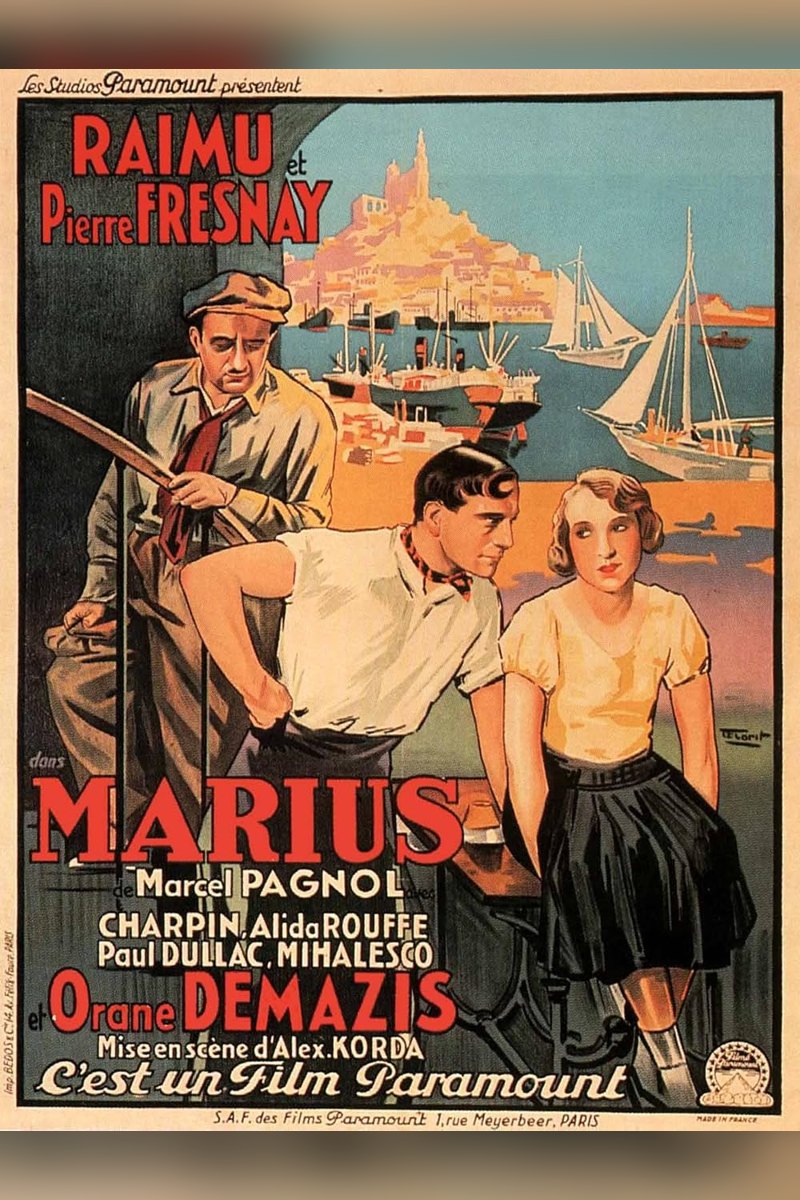
Marius (1931) · Alexander Korda
Ishmael, had he never joined the Pequod
“If they but knew it, almost all men in their degree, some time or other, cherish very nearly the same feelings towards the ocean with me” - Ishmael, Moby-Dick
The first film in Marcel Pagnol’s Marseilles trilogy, and what is without question the greatest film from the EARLY sound-era I have ever seen. How I would sell the character of Marius, the titular character who you are most following over the course of this two-hour delight, is Ishmael from Moby-Dick if he never joined Ahab’s whaling voyage on the Pequod. What anybody who has read Moby-Dick can instantly tell you about Ishmael and his character is that the shore is his bane while the sea is his home. It is not so much the destination which matters to Ishmael, but rather the journey. The simple joys and delights that come with being at sea which so drives off his spleen and regulates his circulation. Watching Marius was like watching a two-hour film in which you are watching the very inner-demons and struggles Ishmael himself would probably face as he contemplates his life and choices on shore.
“I’m leaving. Anywhere. Far away. I’m just leaving.”, does Marius proclaim to his love, Fanny, Fanny whose greatest struggle for the entirety of the film is in her quest to keep her love on shore, even when his desire to leave outweighs the love he has for Fanny. A true compelling set of circumstances where every character is right but every character is also wrong. The hypocrisy is complex, yet so resonant.
I would even go so far to compare Marius as a character even to that of Tony Manero from Saturday Night Fever - a soul who is trapped within the confines of their environment, a soul who can see that their life is going nowhere and only is he destined to follow in the footsteps of his father, Cesar, who will one day with his passing take over the café he owns by the shore, and a soul who recognizes the futility of any kind of enrichment in mind, body and soul if the conventional life of work, marriage and parenting on the shore Marius chooses to stay behind for.
Such a compelling and complete character-study, with the drama very much progressing and unfolding in the way a stage-play would, for the main attraction of the film is in the camera keeping you and the characters grounded in one place during the extended scenes depicting the naturalism of Marcel Pagnol’s dialogue. Each character is so memorable and iconic in their own way and I’m beyond wrapped that the story does not end here and that there are the two films, Fanny, and, Cesar, to go, which I will continue with for the next two nights.
Reviewed on Letterboxd on 12 March 2025