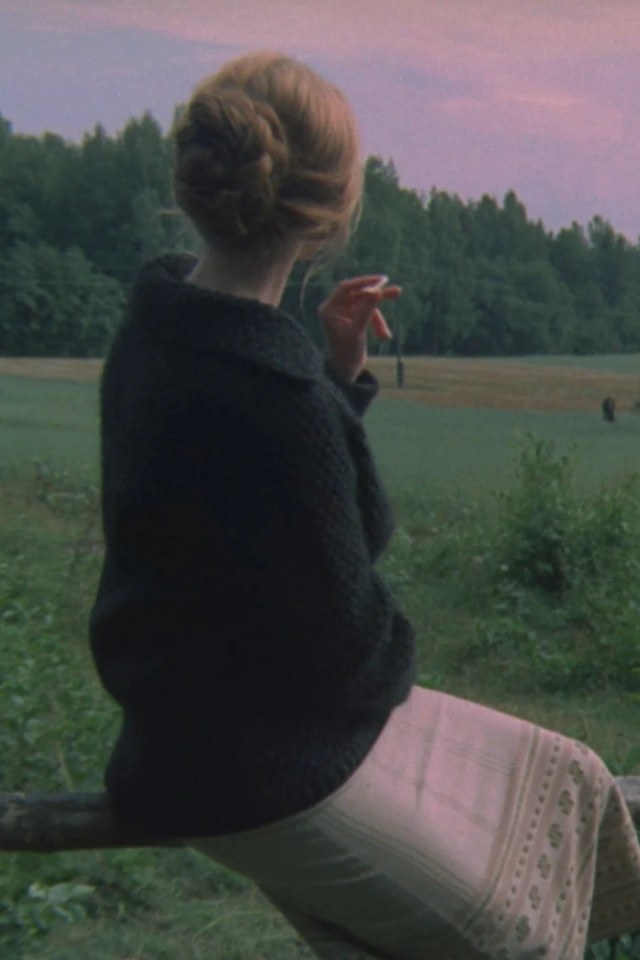
Mirror (1975) · Andrei Tarkovsky
Why Tarkovsky is Tarkovsky
“Your hands are frozen stiff. Now I’ll bring you out of it and you’ll speak clearly and effortlessly, unafraid of your own words and voice”
The central film of Andrei Tarkovsky, as well as the justification as to why Andrei Tarkovsky is Andrei Tarkovsky, both as a human being, and an artist. Only after the film’s one-off opening scene of a teenager breaking free from the confines of his speech impediment (of what I interpret to be the spiritual awakening of the artist from the fears, doubts and pressures they may have in themselves to create and put out the art they make) are we taken back to the days of what is ostensibly the days of Tarkovsky’s childhood. The discourse that the mother and the doctor share alone against the natural backdrop of the greenery of the family’s farm are topics of interest that are raised and expressed in virtually all of Tarkovsky’s work; his reverence for nature and its sentience; nostalgia, childhood and memory, and the sentimental value it holds to one who has grown up, long-past those days when everything was better; the impact that contemporary history, culture and art has on the individual during their lifetime, as well as the dream-like and meditative abstractions of both the conscious and unconscious mind that help only to form the basis of the philosophies and attitudes we, everyday, hold.
Its with Mirror where one can see how our observations, internal struggles, the people in our lives, and the memories we hold can shape and model the voice that the artist holds with their pen or camera; how we take these memories, internal struggles and observations of the world around us and suffuse them into the art we create. Why is there a long-set piece of a house burning down to the ground in The Sacrifice? Mirror has your answer - a childhood memory. Why does Tarkovsky have such a humble care for nature? Mirror has your answer - the very land and greenery he, as a child, was surrounded and exposed to every day. Mirror understands the importance of childhood in the development of the person that five, ten, fifteen, twenty-five, fifty years down the line we become. The word, “Rosebud”, the dying word of Charles Foster Kane, only conjures images and recalled memories in the mind of snow and sleds which take Kane back to the untimely days of his childhood, and not the sixty-something years that passed on by that brought him all the wealth and the power and the fame in the world. Mirror is a true achievement not only in filmmaking, but as a standalone work of art that only could have come from the mind of one who spent a great deal of the time of their day cycling through (similar to the fragmentary way the film is structured) the central, core memories of old from the days they were at their most happiest which make up their very being. Even as a forty-year-old man with ten years of life left in him did Tarkovsky, as evidenced in Mirror, long to return to those days, and I’m sure those days we ALL, at some point upon reflection, wish we could return to ourselves.
Reviewed on Letterboxd on 1 November 2024