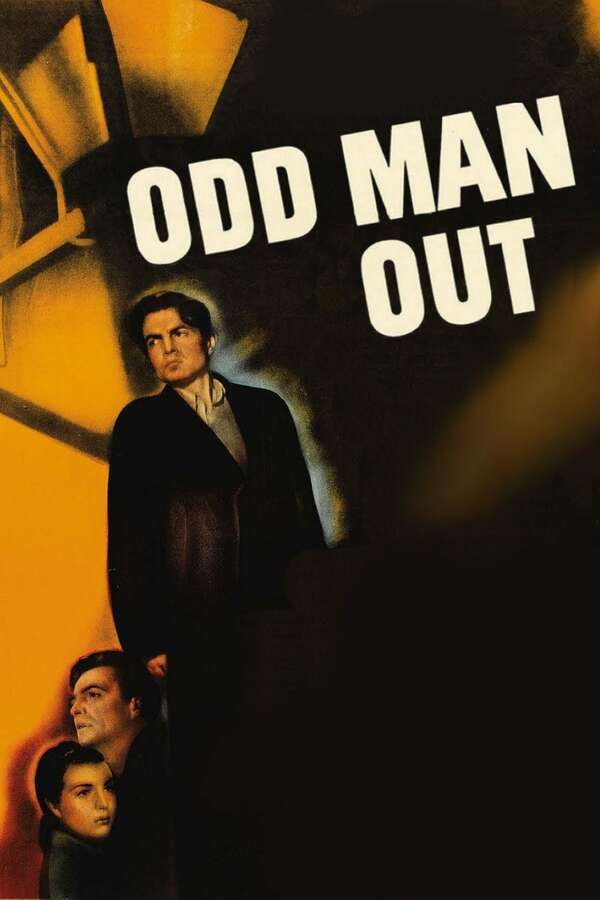
Odd Man Out (1947) · Carol Reed
Dostoevsky on the streets of Belfast
A year before Carol Reed took us to an ever-changing post-war Vienna free of it’s Strauss music, glamour and easy charm in The Third Man, Northern Ireland was our destination, amidst the heated political backdrop of the IRA.
Odd Man Out, to me at least, is quite possibly the closest I’ve seen a film come to perfectly translating and reflecting the writings, themes and philosophies of Dostoevsky’s works in the average film timeframe. A billion times more reflective than some recycled mediocre adaptation could do. If Prince Myshkin from The Idiot killed the pawnbroker and her sister from Crime and Punishment, Odd Man Out would be the outcome. The Dostoevskyian elements of the film shine through the most in the extended scenes of philosophical and religious dialogue between the side characters, all of who just feel straight out of one of his books, especially the eccentric painter, Lukey and his roommate, Shell.
Johnny McQueen (James Mason) is our protagonist, but like Raskolnikov or Prince Myshkin, he’s not the one doing all the talking. That’s left up to all the varying and distinct personalities he encounters as he hazily navigates his way through Belfast from a gunshot wound after a failed robbery. If there’s really a story that perfectly executes the sympathetic painting of a murderer, it’s this one. The instant guilt and regret Johnny feels after the botched robbery wins us over to the point where we’re rooting for him to make it out in the end safely, as opposed to someone like James Cagney in the great gangster film, White Heat, a cold-blooded and remorseless killer who you hate to love but want to see choke in the end. Johnny passes on from person to person, each not knowing exactly what to do and how to deal with him. Do they turn him in or let him go? Are they wanting to turn him in for the moral and justice behind it or is it simply for the reward money? I couldn’t help but think of the Dougie Jones sideplot of Twin Peaks: The Return, seeing a completely helpless, dazed and dying James Mason completely ignored of concern or medical attention.
With further viewings, I’m convinced Odd Man Out will truly become one of my all-time favorites and it may even be better than The Third Man, which is a bold claim to make considering that’s one of the greatest of all time. I think this film is much more atmospheric in it’s cinematography and mood, the changing of climate between rain and snow is absolutely stunning to see amidst the crisp black and white and I just prefer the characters here and what this film has to offer. It’s a phenomenal companion piece with The Third Man no doubt, the only thing holding it back for me a little at this present moment is that, although never really explicitly talked about, a lot of the political aspects and allegory of the film did go over my head as I’m not really knowledgeable on Irish history to this extent. Nevertheless, Odd Man Out is a great underrated gem of film noir, and one that deserves more stature.
Reviewed on Letterboxd on 6 January 2024