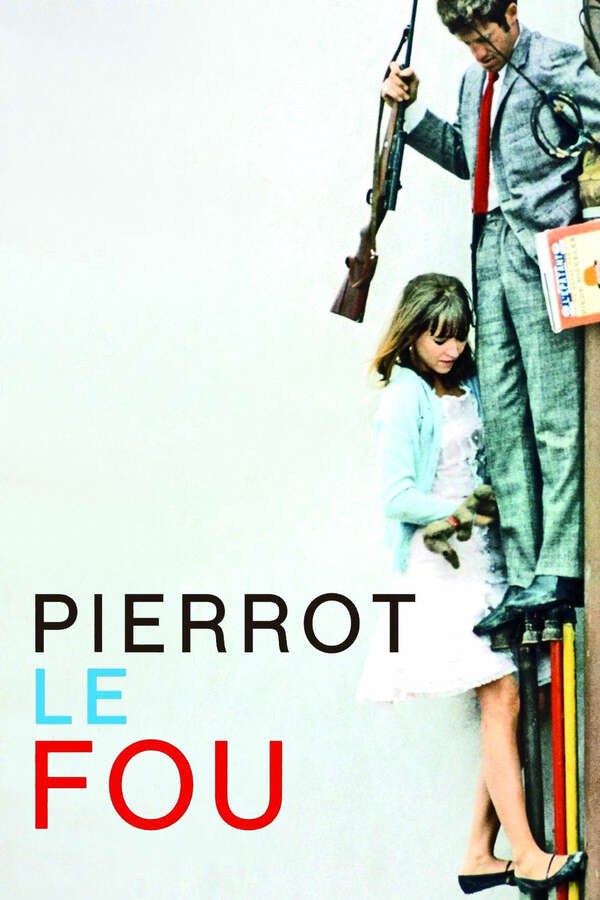
Pierrot le Fou (1965) · Jean-Luc Godard
Life may be sad, but it's always beautiful
“By 1965 there’ll be total depravity. How squalid everything will be.”
How right Fellini was with that essential line from La Dolce Vita, for with the release of Pierrot le Fou in 1965, post-war Europe had become all that the film had predicted only five years before; commercialism, Vietnam, Coca-Cola and the scorn, ridicule and death of both the poet and poetry. A resonant tale of a man’s complete rejection of modernity, for overwhelmed by the changing culture and society around him is Pierrot, and the disconnection he can’t help but feel to a new world that no longer embraces the ideas of the old one. Nothing of what he deems good or of substance is there in this man’s home and professional life, which so prompts him to leave everything behind for a life of pleasure on the run. But that too, a life of pleasure on the run does he come to learn houses nothing but the same feelings of angst, disconnection and heartbreak that the normal everyday life we live through everyday houses. So where then does one go? What escape on Earth is there for someone so painfully at a loss of where exactly to turn too? Such an escape on Earth, is there?
As well as being an innovative, master filmmaker, I don’t think Godard gets enough credit for being a true satirist. An outrageous claim it is not to make that a film like Pierrot le Fou really was just an episode of South Park of its day. Whereas a film like La Dolce Vita was trying to warn Europe and the rest of the world of cultural modernism and the dire consequences it would have on its people, a somewhat light-hearted, dark, twisted, yet comedic spin on the absurdity of what was then contemporary life could Godard not have helped poking fun at. What better way to get to the absolute crux of the absurdity of an issue than with humor, as something like South Park so manages to do episode after episode.
“First there was Greek civilization. Then there was the Renaissance. Now we’re entering the age of the Ass.”.
Godard’s extension to Fellini’s 1965 prediction from La Dolce Vita. I mean, what more can possibly be said about this absolute prophetic line? The age of the Ass did society soon enter, and the age of the Ass is society unfortunately still stuck in, with many thanks no doubt to the commercialism the film flashes before our eyes which, with the passing of time, normalized these promiscuous images and thoughts have become to the mindset of our everyday psyche.
“Life may be sad, but it’s always beautiful!”.
A line uttered by Belmondo about halfway during the film, where peacefully and pleasantly he and Anna Karina are blissfully driving at their own pace, without a care in the world through the green and blue of France’s Riviera. Amidst the humor, absurdity, pessimism and sadness that runs throughout the entirety of Pierrot le Fou, much beauty too there also is and out of his way Godard really went to show his audience just that, whether it be between Belmondo and Karina’s love affair, the music, the philosophy and the calmness and stillness of nature and the sea, this beauty does he get across in such a moving manner, and I very much believe that the final shot of this film is a summarization of this very line.
Pierrot le Fou is my absolute favourite film from Godard. I think it’s his masterpiece, I think its where he truly peaked, I believe its where Jean-Paul Belmondo and Anna Karina both peaked too, and in my book, IS the crowning jewel of not only the French New-Wave and all that it stood for, but one of the crowning jewels of French cinema as a whole. A comfort watch I can see over and over and over again.
Reviewed on Letterboxd on 3 September 2024