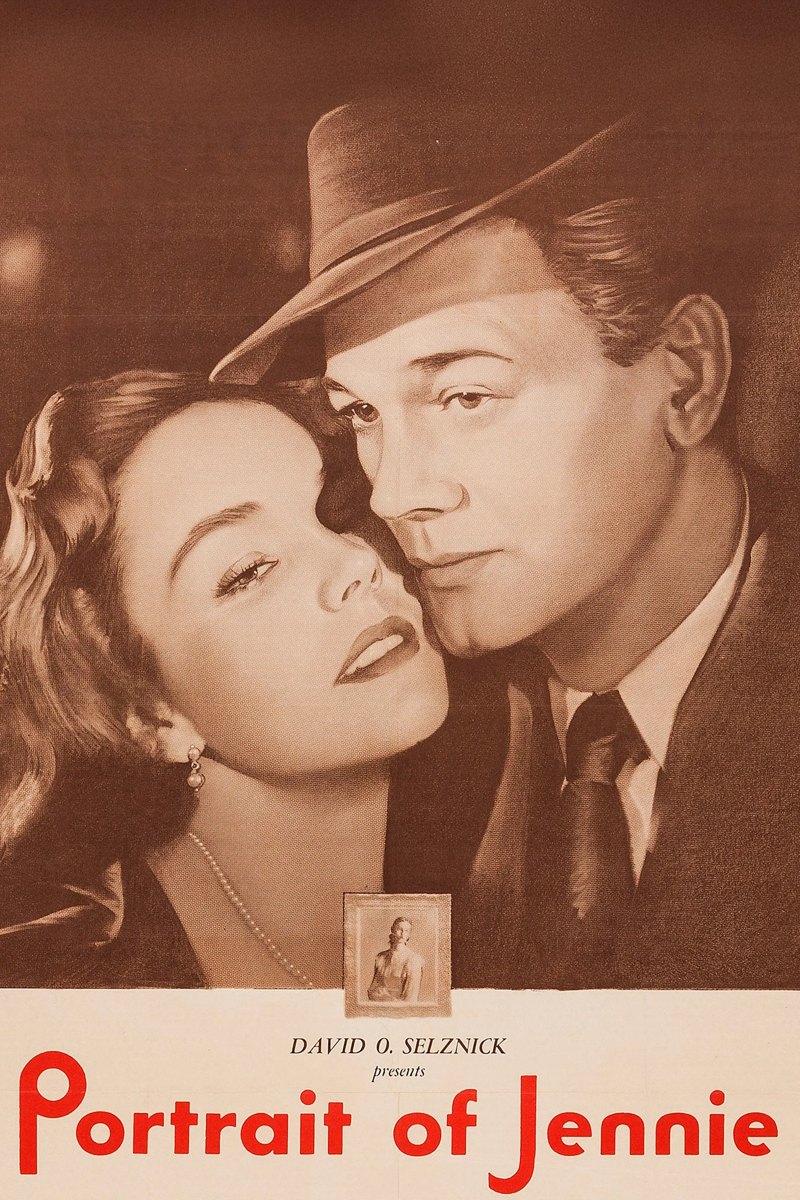
Portrait of Jennie (1948) · William Dieterle
The universe, and the muse who inspired it
“I think just the idea of a woman is so inspiring. I love the mystery of a woman. I just love them so much, and they make me dream. Women are very, very special.” - David Lynch
While watching The Jungle Book last night, what I took the most away from the film is the idea it was trying to reinforce that the beauty of women rivals the glory of nature itself. Mowgli spends the entire story in defiance of Bagheera and Baloo’s desire to see him join the people of the man-village. Mowgli’s stubbornness to leave the jungle and join his own kind is completely justified when you take into account the fact that the jungle and it’s surrounding nature is all he has ever in his life known. But what causes Mowgli to finally change his mind, a mind that couldn’t be swayed for the entirety of the film by both Bagheera or Baloo, is the first sight his eyes ever laid on the beauty of a human woman. 78 minutes worth of stubbornness, completely thrown out the window during the final five minutes when Mowgli decides to follow the woman back to the man-village, and away from the wilderness, choosing the beauty of a woman he has known for five minutes over the beauty of nature he has been surrounded by all his life.
If we are to believe the idea that the universe is a creation, and a God is it’s creator, then technically, the stars, the planets, the heavens and existence itself is a work of art, and God is the artist responsible. If the universe is a work of art, then it is the supreme and objective greatest work of art in all of existence. That there can be no question of.
While watching Portrait of Jennie, I came to think about the many great works of art in all of human history whose form was inspired by a woman. If Lisa del Giocondo never existed, Da Vinci would never have painted the Mona Lisa. Had Beatrice Portinari never lived, The Divine Comedy would Dante never have composed. Without Aphrodite, Venus de Milo would Alexandros have never sculpted. Without Pattie Boyd, Something and Layla would George Harrison and Eric Clapton never have written. The profound impact of the muse throughout the history of art and literature I could continue to give examples of. Zelda Fitzgerald on F. Scott. Nora Barnacle on James Joyce. Edie Sedgwick on Andy Warhol. Some of the greatest works of art the world has ever known exist because of the very existence of a muse, and their profound impact on the artist.
With all I’ve said now in mind, of the Jungle Book’s idea of the beauty of women rivalling that of nature, of the universe being a work of art and God an artist, and of the impact of the muse on the artist and their art, the thought which hit me deeply halfway through watching Portrait of Jennie was this - what if God created the universe, and the stars, the planets, the heavens, and existence, in honor of a divine beauty who served as His muse? Some of the most meaningful works of art in human history were made to do just that - honor the beauty, the impact, and the memory of the women who inspired their creativity. Is it so outrageous then to consider the idea that God may have been inspired by a divine beauty in the way we human beings are when we create? Never in the eyes of the artist does their art outshine the beauty and being of their muse. If God did indeed create the universe, the undisputed masterwork of all art, in honor of a divine beauty, then to His eyes there is no other being in all of existence whose beauty exceeds that of His muse. That then must mean that the greatest beauty in all of existence is not the stars, or the planets, or the heavens or nature, but the divine beauty of women, for without that divine beauty, a possibility it is that the very universe wouldn’t exist, and without the existence of women on the Earth, we ourselves wouldn’t exist.
Don’t let Portrait of Jennie’s simple Letterboxd synopsis deceive you, for it is up there with Peter Ibbetson for being one of classic Hollywood’s most spiritual experiences, whose metaphysical ideas don’t just extend to those associated with Christianity.
Reviewed on Letterboxd on 16 May 2025