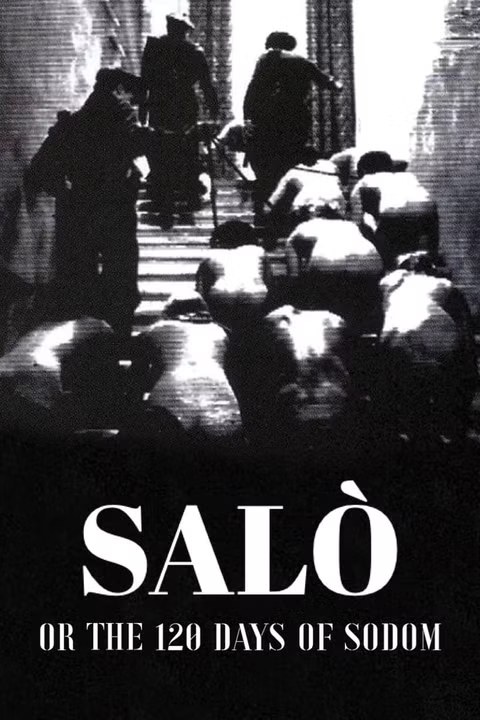
Salò, or the 120 Days of Sodom (1975) · Pier Paolo Pasolini
What one person is capable of doing to another
“Kill me! At least God, whom I implore, will pity me. Kill me, but don’t dishonor me”
If you were to put a gun to my head and ask me quick, before the trigger you pull, what I think the most dangerous weapon ever created is, the atomic bomb, nor the firearm would I respond with; hands, I believe, are the most dangerous creation; the first weapon; not artificially made as the gun or the bomb, but naturally; without the hands, the trigger could one not pull, and the nuclear launch keys could one not turn. Our hands do we take for granted simply because its impossible to imagine anyone being born without them. How hard would life then become if one day you woke up and discovered that your hands were missing? A cup of coffee could you no longer bring to your lips; through the drive-thru you could no longer go; a piece of writing you could never pen or type again. If one day every single human being on the planet were to wake up and discover that their hands were missing, safe it is to say that civilization, and humanity, wouldn’t last much longer. The only silver-lining of this fantastical phenomenon - the complete suspension of evil.
I had the displeasure recently to read the source material that Salo is based on, The 120 Days of Sodom, written by The Marquis de Sade in the years leading up to the French Revolution in the late 18th century. Not to dismiss the horror of the film by any means, but in comparison, and those who have read the book can attest to this too no doubt, that the book makes Pasolini’s adaptation look like Mr Rogers. Never have I read anything more unabashedly depraved in all my life. I can however at least appreciate what the Marquis was trying to convey with this story; a story that goes deep into the very nature of human evil; where it comes from, how its spread, and how it blossoms in the influence of one’s mind until the day comes where these influences they finally act on. Abundantly clear do both the Marquis and Pasolini make it that nothing do the four libertines have to gain from the subjugation of the victims they have held captive other than to gratify the inner evil of their sexual desires; this inner-evil that they do not shun, but wholeheartedly embrace with open arms. Hopelessness prevails and God’s silence is deafening. Pasolini’s decision to re-imagine the film’s setting and political context from late 18th century France to Fascist-era Italy is a choice that I admire very much as I believe that this is his way of reinforcing the idea (the only hope and glimmer of light throughout the whole film) that good will in the end always triumph over evil, because when the year 1945 finally rolls around, the political power that these four fascist libertines have will be completely stripped.
I think because of how memed Salo has become in the film community that one will instantly dismiss its merit and its commentary just based solely on the reputation of the film’s content, even if they’ve never actually seen it or understand where the story originally comes from. It certainly is not an easy watch, but I believe it to be an important watch, as I believe Salo to be one of the greatest films ever made of the horrors of what one person has the shocking capability to do to another. Pasolini did not adapt Salo to simply just shock or offend for the sake of being edgy. If what’s happened in the last six years with Jeffrey Epstein, and now recently with Diddy, has left a mark on anything, its the reminder that we still live in a world that continues to find out that shocking acts of depravity such as the ones depicted here still continue to happen, specifically in the presence of the powerful and elite. Why? For the obvious reason, because all the money and all the power do they have in the world to do so. Human nature it is to want gratification. In many different forms can gratification come in, and for a very select few, deeply depraved, and sick, and twisted beyond the realm of all moral good does that seek for gratification go. That is what I believe Salo stands for; a fight and a plea and a reminder to the public of what human beings seeking the most depraved of gratification are capable of. At the end of the day, Salo is only a movie, and The 120 Of Sodom is only a book, which makes reality all the more terrifying as no doubt worse has taken place on this Earth than what has been depicted in these two works.
Reviewed on Letterboxd on 30 November 2024