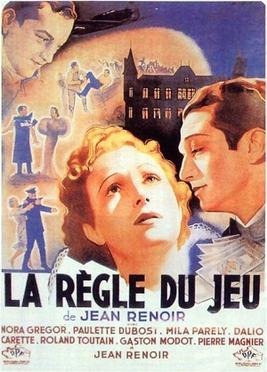
The Rules of the Game (1939) · Jean Renoir
The game never ends, but we do
“The rules of the game are those which must be observed in society if one wishes to avoid being crushed. But what I truly want to convey in this film is my great love for women. To do this, I have to show men, men who talk about women, who say everything that can be said about them.” - Jean Renoir
It’s very easy for one to see The Rules of the Game today, a film that has maintained a strong reputation since it’s reconstruction in the late 1950s as one of the most lauded, revered and influential films ever made, and come out of it on a first viewing completely underwhelmed, especially to those unfamiliar with Jean Renoir’s familiar tackling of class, his soft-hearted picture of the working class and his scathing attitudes toward the bourgeoisie of the time, seen in many of his works prior to Rules. You watch it today and you may be bewildered as to how it generated such hostile reactions at the time of its release. It was booed, it was banned, it was a financial disaster, someone lit a newspaper in the theatre with the intention of burning it down and 1/4 of it was thought to be lost forever at one point.
The Rules Of The Game is many things. A middle finger to the bourgeoisie and their callousness. A cautionary tale of the great moral decline which, by September ’39 with the breakout of WWII, two months after the films release, proved to come true. Amidst all the beauty, poetry and humour is pessimism. But like all the great works ever made, our true central idea is love. Or rather, the inability to share your love with the one you love, as is heartbreakingly told with such empathetic prowess here by Renoir. To walk out of a viewing of The Rules of the Game and not feel like the entire world around you has just shattered into a million pieces, impossible to put back together, is a difficult vision to envision.
“I’m very unhappy. I’ve never been so disappointed in my life. I made this flight for a woman. She’s not here to welcome me. She didn’t even bother.”
Is there a worse feeling than just that? Giving everything you’ve got, your heart, your soul, your energy, your courage, for the one you love, the only person you could ever imagine going through the ups, downs and absurdities of life with, only to have it all thrown SMACK-BANG back at your face as if it were a dirty rag? Only someone who endured through the pain of such a sadness could have made this film. And one of the ways people hide their tears is through humour. As we see toward the conclusion, perhaps death is a much more liberating and welcoming prospect than the torture of having to live through every single waking moment with a broken heart, still longing for that one person, till death do you part. The petals of true love never die. They continue to blossom even when the sun is hidden by the clouds and the rain continues to fall.
In just one location over the course of a night, Renoir gives us a taste of the absurdities of the human experience. The absurdity of manners, the absurdity of class, the absurdity of comedy, of callousness, of pride, of lying, love, tears, heartbreak, violence and death. In one night, all these things are revealed, so much so that they overwhelm us the same way they overwhelm the characters. And all that influx of differing, runaway emotions slowly culminates into irrationality. And out of that irrationality two things can come out. Regretful mistakes committed in a temporary state of delirium or, unfortunately, ones own true colors. Makes you think of the films standout line. “The truly terrible thing is that everyone has their reasons.” There’s no better summation of why it is we do the things we do. Reasons. The driving force behind the history of our history.
Perhaps the accessibility of The Rules of the Game to modern audiences wouldn’t hit the same as it did back in the 20th century, but to the meek-hearted, it’s sure to forever remain a lasting work of immense power. It’s definitely one that grows on you the more you revisit it. You’re never truly done with this film. Every frame says a thousand words. Each time I’ve seen it, I’ve felt compelled to rewatch it again right away. A recent reading of Andre Bazin’s famous book on Jean Renoir really gave me a much greater understanding and appreciation on the man.
We take part in the rules of the game every single moment of every single day, even when we’re not conscious of it. The game of life, love and class. But like all games, there’s always going to be that one person who tries to cheat the rules at some point. Once caught, there’s no joining back.
The game never ends, but we do.
Reviewed on Letterboxd on 10 February 2024