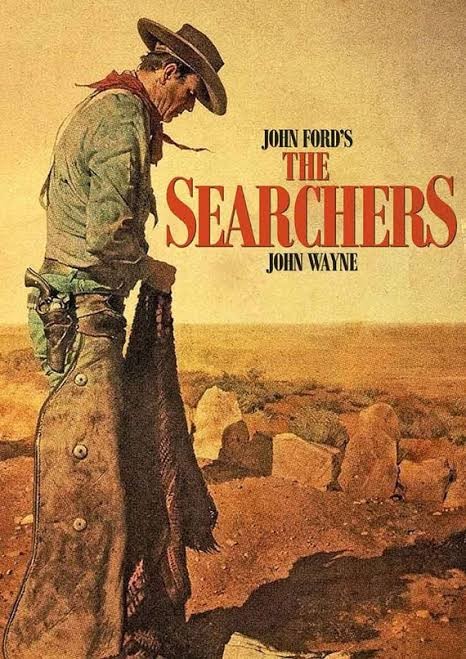
The Searchers (1956) · John Ford
Why The Searchers?
“What makes a man to wonder?
What makes a man to roam?
What makes a man leave bed and board and turn his back on home?
Ride away…
ride away…
ride away…”
Thus are the questions the Sons of the Pioneers raise during the opening to John Ford’s 1956 masterpiece, The Searchers; not only one of the all-time great westerns, (arguably THE greatest) but one of the greatest films to have ever graced the silver screen, period.
A single view of any of Ford’s films is never enough to do complete justice. For the hundreds of screenplays that he chose to work with, there’s always such a strong, profound complexity not only to the characters and their motivations but also the depth of the stories and the lengths and levels they go to, emotionally and thematically.
The films from Ford that I believe greatly achieve these levels are the ones whose screenplays were written by Frank S. Nugent, from which we received, Fort Apache, She Wore a Yellow Ribbon, Wagon Master, The Quiet Man, and of course, The Searchers. All these films (except for Wagon Master), star a much more humble and kind John Wayne. A John Wayne of true leadership, bravery, and empathy. Then we’re introduced to John Wayne of The Searchers, our protagonist, Ethan Edwards, the complete antithesis of all these previous men; A confederate civil-war veteran who refuses to recognize and acknowledge the South’s defeat. A critter who just keeps coming on.
Out of all of Nugent’s screenplays and Ford’s films, The Searchers to me is the very pinnacle of their abilities as writer and director and the one filled with the most profound psychological depth, complexity, allegory, and richness. It’s a film I could talk endlessly about, shamelessly devoting hours upon hours discussing a lone aspect before moving on to the next.
But why?
Why The Searchers?
Out of all the Western films ever made and of all the John Wayne films and of all the John Ford films and of all the Classic Hollywood films and of ALL the films ever made in the world, period, why is it that The Searchers is a strong contender for perhaps the greatest film I’ve ever seen? Or that Martin Scorsese has ever seen? Or that Steven Spielberg has ever seen? Or David Lean? Or Jean-Luc Godard? Or George Lucas? What is it about this single film that has taken hold of so many filmmakers and cinephiles since 1956?
Something I recently pointed out to myself that unnerved me for quite a while because of how unintentional it was is the fact that my top three favorite films, Blue Velvet, Taxi Driver, and The Searchers all tell the exact same story. A vigilante taking the law into his hands to rescue a girl from their captor, the only true differences being some of the characterization, the environment and period its set. The basic layout is all the same, however. Blue Velvet is more optimistic and hopeful, Taxi Driver is more pessimistic and bleaker, and The Searchers is this strange phenomenon that sits in the middle, bordering between this optimism and pessimism as if it were a constant never-ending battle, like a yin and yang.
Now I don’t know what this means exactly but I find it fascinating that out of the thousands of films that I’ve seen, I’ve boiled it down to these three being my favorite. And that may have to do with the fact that first and foremost, these three films are very much about ideas I find the most resonance with - loneliness, identity and making yourself up in a world and way of life where you just can’t conform with the others.
I find The Searchers the most interesting of the three because compared to Jeffrey Beaumont or Travis Bickle, Ethan Edwards is much older, much wiser, and, in the context of the Old West, much more street-smart. Yet even with age, he proves to the audience that not only does he still have a lot to learn, but he also hasn’t truly found peace within himself.
“A man will search his heart and soul
Go searchin’ way out there
Yes, peace of mind he knows he’ll find
But where, oh Lord, oh where?”
And thus is the final question the Sons of the Pioneers pose before the door shuts on John Wayne, in what is perhaps the finest ending in all of cinema. Where does an outcast like Ethan find peace of mind? Is it even possible to attain?
The most impressive aspect of The Searchers that I use myself as a textbook guide for how to achieve the art of showing and not telling, is the film’s hidden subplot: the secret love affair between Ethan and his brother’s wife, Martha, AKA, the holy grail of visual subtlety. I couldn’t even think of a second or a third example. This hidden subplot is the driving force behind everything Ethan does on-screen. The film is called, “The Searchers”. Yet is Debbie the person of interest for Ethan? Or perhaps her captor, Scar, the leader of the Comanches? Or…is The Searchers really just Ethan’s quest to avenge the death of Martha? Each are valid, but to me, Martha is the most essential person of interest.
I recently saw Ford’s 1935 film, The Informer, in which we’re given a thematically similar protagonist by the name of Gypo Nolan, who rats out his best friend, wanted for murder, to the police in exchange for a 20-pound reward that would have taken him and his love, Katie, to board a ship to America to find a new way of life. What’s the driving force behind Gypo’s need to rat? Love. As is the case for Ethan. One of the most fascinating things Ford accomplishes is how he makes his audience sympathize with these characters, despite their flawed and questionable actions on screen. There really is a fine line where you can’t look at these people with contempt, but pity, because Gypo and Ethan are given every single possible reason in the world of their environments to believe and do what they do. Gypo’s out of work, out on the streets, a drunk without a cent to his name, yet what he does have is his love. Ethan is a wanderer, presumably wanted and consistently on the run, yet his love for Martha remains. Hence why he returns to his brother’s farmstead at the start of the film in the first place. You can’t keep away from your true love forever, which in Ethan’s case is confirmed to be a eight-year separation. Oddly enough, the same age as his “niece”, Debbie. Makes you wonder, doesn’t it?
The Searchers is chock-full of some of the best scenes Ford ever directed but one that REALLY sticks out to me is the final scene shared by Ethan and Martha, in which she hands him his hat, jumper and apparel before going with the rest of Ward Bond’s posse to investigate a series of cattle murders that have taken place, revealed to be a ploy by the Comanche to ambush one of the farmsteads, clear of artillery. There is so much said in this one beautiful moment, without a single word uttered. It’s there. That love is there. No matter how forbidden it is, it’s genuine. The way they quietly gaze into one another’s eyes before softly embracing, with that final kiss goodbye that Ethan plants on her forehead. This is a scene that may completely go over one’s head the first time but it’s probably one of the key scenes to understanding the film. Now this may just be nothing more than a simple kiss goodbye to his brother’s wife that we’re misinterpreting here, but I find the following scene interesting, in which Ethan returns with Jeffrey Hunter’s character, Marty, to the farmstead, only to see it on fire and burning to the ground by the Comanche.
That lone death-defying stare Ethan gives as he watches the farm burn. He doesn’t want it to be true, but he knows the ways of his enemies. As the age old saying goes, if you want to know your enemy, you become your enemy, probably one of the reasons why we later find out that not only does he understand the Comanche language, but can speak it.
Ethan charges to the burning farmstead, and you’d think in this one moment the first person he’d be trying to look for is his brother, Aaron. His own flesh and blood he’s known since birth. Or at least his nieces and nephew. But no. His priority isn’t on them but on Martha, for the first and only name he starts screaming out for once he pushes through the fog of smoke in the hope for a response is hers. Not Aaron, not Ben, not Lucy, not Debbie, but Martha. And as soon as he finds her corpse, in what is easily the most haunting shot of the film in which Ford leaves the image of her desecrated body to our imagination, the heart of this strong, silent man splits in two. A dress ripped to shreds on the desert sand is enough to tell us of the darker elements of this atrocity. And out of that heartbreak, comes a poisoned heart, for his quest for revenge is born, setting up the events of the rest of the film. The search. The search in where he becomes obsessive, puts irrationality before rationality, and declares his firm belief in finding them, “as sure as the turning of the Earth”. Emphasis on the word, “them”, and not the word, “her”.
We get another look of this very heartbreak take place not too long after these events, in which Brad Jorgensen (Harry Carey Jr.), the sweetheart of Ethan’s niece, Lucy, discovers that she too had been kidnapped, presumably raped and left for dead in a canyon by the Comanche. Yet unlike Ethan, Brad doesn’t have the heart to contain his inner rage. His emotions get in the way of his rationality and in a state of sympathetic delirium, charges into the Comanche camp before being gunned down himself. As the lyric goes in Marty Robbins’, El Paso, “my love is stronger than my fear of death.”
What’s been a strong topic of debate among fans of The Searchers is why Ethan doesn’t kill Debbie during the film’s final climax, after he was very ready to do just that during the scene where she runs down the hill from the Comanche encampment. It makes a lot of sense that he would in that moment, considering the racial prejudice of the character we’ve been following, for in the years that she has been in the company of the Comanche, Debbie has become one with their culture and way of life. Speaking their tongue, wearing their clothes, and braiding her hair in the style of their women. Some could argue this sudden change of heart is just poor writing to tie up loose ends and bring the story to an abrupt and happy close, but I’d disagree with that conclusion. From everything we’ve gone over about Ethan’s love for Martha, it all builds up to the culmination in which Ward Bond’s posse, along with a group of cavalrymen, lead the final charge into the Comanche’s territory. It’s in this scene where Ethan finally lets loose and acts out on all his inner rage, all his inner prejudice, towards the Comanche to finally deliver justice to Martha’s name. And once he finds Scar dead in his tent, (killed by Jeffrey Hunter: also in a way, his own revenge for the death of his mother who we learn Scar too murdered when he was a baby) his prioritized quest for vengeance ends right there and then. What more does he have to gain? What more does he have to uphold and avenge? All he can do in this moment is move on to his next priority like a leech. The priority that should have been his number one concern from the start. Finding Debbie and bringing her back home. For the first time in the film, we truly see a genuine sense of rationality from Ethan once his true quest has been fulfilled. To save the only surviving flesh and blood born from the love of his life, Martha. And if the hints and gestures that the film try to convey early on are correct, this isn’t a reunion between uncle and niece, but a reunion between father and daughter.
“Let’s go home, Debbie.”
I don’t think there’s ever been a viewing I’ve heard John Wayne deliver those words (with Max Steiner’s beautiful score playing in the back) and not become teary-eyed. The most noble act of Ethan in the entire film. Maybe not enough for a true, true redemption, but one where we can nod, smile, and say, “you done good this time, Ethan. You done good.”
Jean-Luc Godard once famously compared the final reunion of Ethan with Debbie to that of Ulysses with his son, Telemachus, in Homer’s Odyssey. A fine, fine comparison, for those two moments in both texts are exactly what we’ve been waiting for since the first word and the first reel. The fine culmination of all that longing, all that travel, all that desperation, all that rage and all that searching from a never-ending series of death-defying adventures, has built up to this one eternal, human moment. That of reunion.
The climax of all three films, Blue Velvet, Taxi Driver, and The Searchers are the same. Our protagonist saves the girl from their captor and return to their way of life. In terms of the final scenes, Taxi Driver and The Searchers share the most in common than Blue Velvet’s happy, neatly wrapped bowtie ending. Both films end exactly where they begin. De Niro driving toward us and De Niro driving away. The front door opened on John Wayne riding his horse toward us and the closing of the door on John Wayne walking away. Scorsese himself even said he was really just remaking The Searchers with Taxi Driver.
Even after everything we’ve just spent two hours seeing, these characters continue to remain ticking time bombs. Ticking time bombs drifting in their respective environments until the next series of purpose comes along. This purpose nullifies their loneliness. Ethan is just like the soul of the Comanche whose dead body him and Ward Bond’s posse unearth from the ground. Ethan shoots both the eyes out of this corpse, before telling us of the Comanche’s belief that without the eyes from their body, they can’t enter the spirit land and are destined to become blind wanderers between the winds. Blind wanderers that can’t find their way to this eternal paradise. So too, Ethan has become a blind wanderer amidst the desert sand that the wind will continue to blow in his face, searching for the spirit land not on the other side, but on this earthly plane, in the hope of finding his peace of mind.
But where, oh lord, oh where?
Ride away…
Ride away…
Ride away…
Reviewed on Letterboxd on 7 February 2024