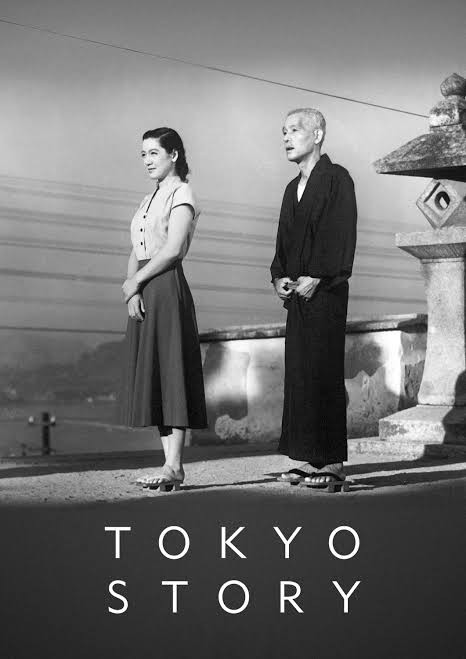
Tokyo Story (1953) · Yasujirō Ozu
The most human film ever made
A culmination of Ozu’s entire filmography up until this point. Only few filmmakers instantly spring to mind who perfectly executed the human experience on camera. Bergman, Tarkovsky, Fellini, Antonioni, but after revisiting Tokyo Story, I firmly believe that Ozu may have been the one who perfected this the most.
Tokyo Story was a film I already held in high regard and it holds a special place in my heart because (besides the REC. franchise) it was actually the first foreign-language film I ever saw, and it was the red-pill to later discovering so many great films and filmmakers who in the time I’ve gotten to know their works have genuinely changed my life, taught me many lessons on life, filmmaking and composition, and continue to leave a huge impact.
This already left a huge impression on me when I first saw it at the start of 2020, and although I had admittedly forgotten quite a bit of what happened in the film prior to now, it’s still continued to stick with me. Something that Ozu tries to communicate in his films is that life is simply a cycle and trying to break that cycle is impossible, no matter how hard you try, and there’s no better film than Tokyo Story that gets this idea across. The film is so simple, minimal and easy to digest but it leaves you with so much to think about afterwards.
If my memory is correct, this is the first time in an Ozu film where he directed a death scene. About a month after seeing this the first time, I lost an elderly relative very suddenly, and when my family and other relatives went to see him in the hospital, it was extremely harrowing seeing this man who I always saw with a smile and laugh now in a coma, struggling to breathe and slowly passing. It was really difficult to witness and scenes from this film were replaying in my head during this time. It wasn’t until the wake and funeral, seeing his body at peace and his face for the last time where I found catharsis and realized that although the prospect of never seeing him again was sad, this was somebody who came from the villages in Greece, immigrated to Australia, found opportunity and a job, met a wife, had kids and made a life for himself. And I’m beyond positive that he had absolutely no regrets for any of it. What was a day for mourning suddenly became a celebration of the life he led. Revisiting Tokyo Story, I was able to bring this experience in to my viewing and it affected me much more this time.
The film also looks at the passage of time, the generational gaps between the youth and the old and the change and westernization in post-war Japan through the eyes of the film’s elderly couple, further cementing Ozu’s ideas that life is just a cycle. I wouldn’t be surprised if Antonioni were influenced by this, because this actually does feel like a light-weight precursor to something like L’Avventura or La Notte.
Despite there being a huge cultural difference, the ideas represented in Tokyo Story is universal and anybody from any race, any culture, any religion can take away what Ozu has to say. This is probably the most human film ever made, and deserves it’s reputation as one of the greatest films in the history of cinema.
Reviewed on Letterboxd on 21 May 2023