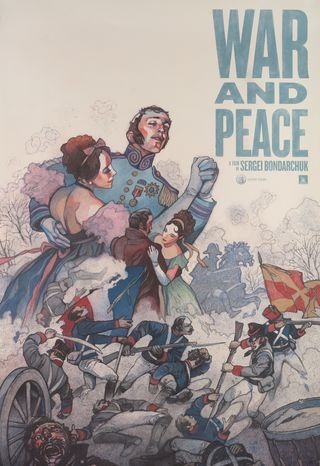
War and Peace (1966) · Sergei Bondarchuk
The grandest epic to have ever graced the silver screen
Last year, over the course of a month, I tackled the mission of getting through Leo Tolstoy’s mammoth of a book, War and Peace. This is a book where you’re not just reading the events taking place, you’re living them. You live through the soirees and the waltzes and the dinners and the conflicts and the love affairs and the philosophy and the horrifying scenes of war. From page one, you grow, age, learn and mature with these characters right until the very end and it never lets you go for a single second. And that’s exactly what this adaptation of this work manages to replicate. Even at a runtime of over 7 hours, I still don’t believe this adaptation does the book justice, but that doesn’t take away the fact that out of all the lengthy epics throughout cinema history, Lawrence of Arabia, Ben-Hur, Doctor Zhivago and Gone with the Wind to name a few, Sergei Bondarchuk’s production of War and Peace may very well be the grandest epic to have ever graced the silver screen.
Produced by Mosfilm, with further funding and support from the Soviet authorities and army, not a single penny was wasted on the production, and you can just see how much love and passion went into recreating Tolstoy’s vision. Thousands and thousands of extras and real soviet soldiers and cavalrymen were used for the elaborate battle sequences for the film, which go down as some of the most impressive and hypnotic scenes of war ever shot, specifically the battle of Borodino in part III. It’s just an orchestra of chaos and destruction with jaw-dropping aerial and experimental camerawork. The grander, opulent scenes at the large estate soirees and waltzes are so well choregraphed and endlessly beautiful with the men and women attending dressed so elegantly in their ballroom suits and dresses. The sheer scope and size of this film is mind-blowing.
Something I wasn’t aware of beforehand was the strong dreamlike, surrealistic elements and use of stream of consciousness narration to some of the scenes in this film that you’d probably experience in an Andrei Tarkovsky film like Stalker or Mirror. This makes the film a lot more unique and is probably the only way they could have gotten some of Tolstoy’s philosophy and ideas across to the audience to ponder. There are times where it does feel quite overwhelming and overdone but for the most part, they execute it so perfectly, especially during the scenes where Prince Andrei is injured on the battlefield looking up to the sky and Pierre viewing the great comet of 1811. Just such fantastic and moving filmmaking.
Although the personalities of these characters are perfectly captured, some of the film’s casting I think is a little bit odd. I don’t see Sergei Bondarchuk (the film’s director) as Pierre Bezukhov at all, especially since the character is around twenty-one years old at the start of the book and Bondarchuk would’ve been forty when principal photography took place. Same as Count Ilya Rostov, they made him way too old in this. Ludmila Savelyeva on the other hand, who plays Natasha Rostov, is straight out of Tolstoy’s book. She perfectly exhibits the personality, elegance and innocence of this character, and her performance is so moving to watch. One of the single most perfect casting choices for a literary character I’ve ever seen.
I’m yet to see the 1956 King Vidor version and the 2016 miniseries so I can’t properly judge, but I’m beyond positive they didn’t recapture the magical, monumental and grand levels that this production straight from the motherland managed to depict.
A lot of Russian literature from Dostoyevsky, Tolstoy and Gogol is hard to adapt, War and Peace hands down being the most difficult, and as I said above, although with a 7-hour runtime it still doesn’t do the book justice, it’s still extremely faithful to the events of the book they chose to work with and it’s the closest anybody has ever got to reaching Tolstoy’s level of genius on the big screen. Tolstoy never lived through the fifteen-year period that War and Peace took place in, from 1805 to 1820, but because of his vast amount of knowledge on the history of those years, you’d think he was a first-hand witness to these events. It’s one thing to visualize and create these scenes of love, war and heartbreak in your head so accurately from a time you never even lived but it’s something else to have it play before your eyes as if it were actual footage from the period. Had Tolstoy made it to the 1960s, he would have had tears streaming from his eyes while viewing the adaptation of the work he put his absolute heart and soul in to writing. This is one of the most timeless books ever written and you feel the love for the source material in every frame.
Reviewed on Letterboxd on 20 June 2023