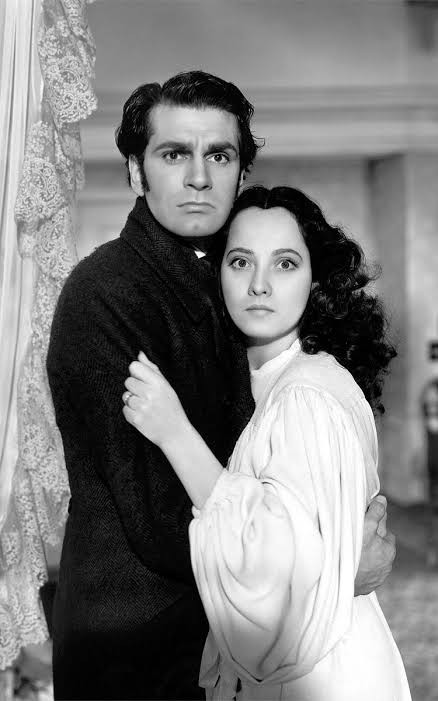
Wuthering Heights (1939) · William Wyler
Wuthering Heights, reimagined as Hollywood romance
“Be with me always. Take any form, drive me mad, only do not leave me in this dark alone where I cannot find you. I cannot live without my life! I cannot die without my soul”.
Avid fans of Wuthering Heights probably would hate William Wyler’s adaptation simply because the bleak pessimism of Emily Brontë’s classic novel has been substituted for classic-Hollywood romanticism. I’m usually not a fan when film adaptations stray from or reimagine completely the source material they are bringing to life, a prime example being the 1999 Talented Mr Ripley film, but I will make a rare and perhaps even hypocritical and biased exception here. The pure classic-Hollywood romanticism is exactly why I enjoyed this adaptation–or rather, reimagining is the better word–of Wuthering Heights.
Heathcliff and Catherine’s love story is one of the most complex and unconventional in all of literature because of how repressed, cold, and cruel it is. Though it is the driving force behind every decision they make, their inner-bitterness disguises their true feelings and motives so much to the point where it feels like the two like to inflict harm on others simply because they get off on it. Heathcliff and Catherine’s love story in the key of classic-Hollywood romanticism is something that, admittedly, apart of me wished existed in the novel. It really is just fan-fiction in which the title remains the same. Instead of the cold, brash, violent, and detestable Heathcliff of the novel, here, played by Laurence Olivier, he’s painted as a handsomely sympathetic and emotionally vulnerable romantic. Because it only adapts the first half of the novel, and completely strips away the drama with Catherine’s daughter and Linton, (who aren’t even in the film) there is a lot more felt emphasis on the tragedy of romance here than in the book, and what it means to love and desire somebody somebody you can’t have due to social circumstances, even if the feelings of love are mutual. While this component exists in the novel, the emphasis is more on the lifelong bitterness and cynicism one who can’t be with the one they love will develop.
If you’ve never read Wuthering Heights but you’re wanting to use this film as a CliffsNotes cheat to give you an outline of the story, you’re better off just reading the book. You either like this film because of it’s romantic classic-Hollywood reimagining, or you detest it entirely because of its unfaithfulness to tone and character. Both are legitimate opinions to have.
Reviewed on Letterboxd on 26 April 2025